AI Research Spotlight: OpenSeeker-v2 Disrupts Search, CropVLM Eyes the Fields, and Agents Get Benchmarked
OpenSeeker-v2: The 10,000-Sample Disruption
A search upstart just proved you don’t need a billion-dollar training budget to compete. OpenSeeker-v2 topped the search leaderboard using only SFT training on 10,000 data samples — a number that makes Big Tech’s trillion-token training runs look wasteful by comparison. The full paper details how the academic team achieved this, and the model is now fully open-sourced for anyone to use.
The implication is uncomfortable for incumbents: if a small team with 10K curated samples can outperform models trained on web-scale data, what exactly are the billions in compute buying?
CropVLM: AI Goes to the Farm
While most AI research targets chatbots and code generation, CropVLM tackles something more grounded: crop analysis. The model mastered 30+ crop varieties through semantic alignment, achieving over 70% classification accuracy — a number that matters when you’re trying to detect disease in a wheat field from drone imagery.
The accompanying HOS-Net framework on GitHub enables zero-shot detection of crop types the model wasn’t explicitly trained on. Automated phenotypic analysis — measuring plant traits at scale — is becoming practical in a way it never was with traditional computer vision.
ClawMark: Agents Are Worse Than You Think
If you’ve been impressed by agent demos, ClawMark will sober you up. This benchmark, designed specifically for AI colleague models in dynamic office scenarios, covers 100+ professional tasks with script-based objective scoring. The result: mainstream models achieve a mere 20% success rate on long workflows.
The gap between demo and reality is stark. Agents that look competent in a three-step task fall apart when the workflow stretches to twenty steps with branching decisions. Adaptability — not capability — is the bottleneck.
AniMatrix: Art Over Physics
AniMatrix takes a deliberately different approach to video generation. Instead of enforcing rigid physics simulation, the model prioritizes artistic expression — the kind of dynamic, exaggerated motion that makes animation feel alive. Its AniCaption system extracts production variables like camera movement, character expression, and scene pacing automatically. The team claims art motion scores far exceed comparable models and has promised to open-source the weights soon.
Microsoft’s Self-Explaining Agents
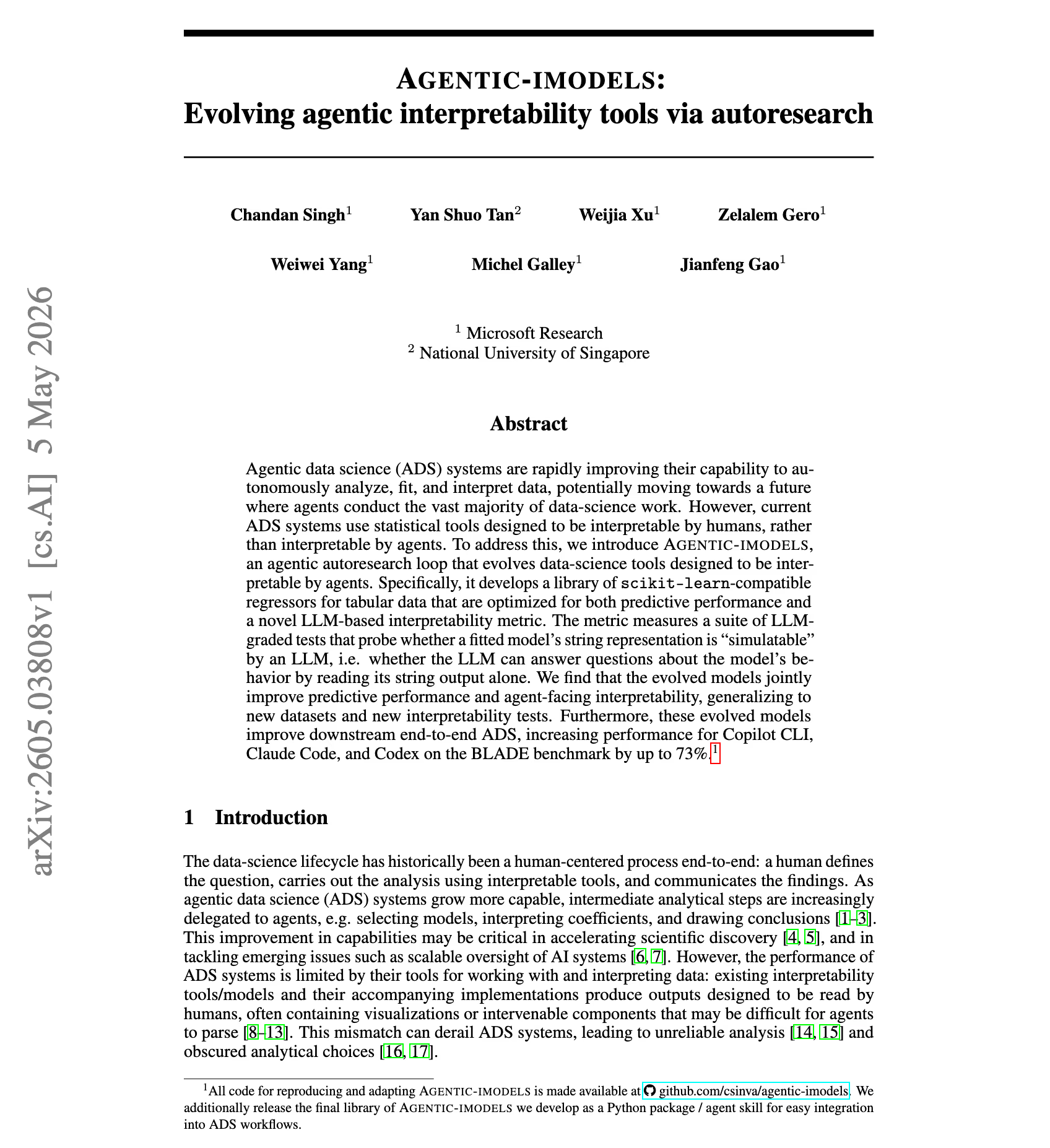
Microsoft Research proposed a novel interpretability framework where agent models autonomously iterate to produce accurate, human-readable regressors. Small models achieve precise predictions by reading string representations rather than crunching tensors — an approach that dramatically outperforms traditional statistical models across dozens of datasets and tops the BLADE benchmark.
Taken together, these five papers tell a consistent story: the frontier is shifting from “bigger models” to smarter training, specialized domains, honest evaluation, and interpretable outputs.