AI Cracks a Geometry Problem: OpenAI Overturns Erdős's 80-Year-Old Unit Distance Conjecture
AI Cracks a Geometry Problem: OpenAI Overturns Erdős’s 80-Year-Old Unit Distance Conjecture
The day AI moved from computation to original mathematical creation
May 20, 2026 — A milestone in mathematics and artificial intelligence history
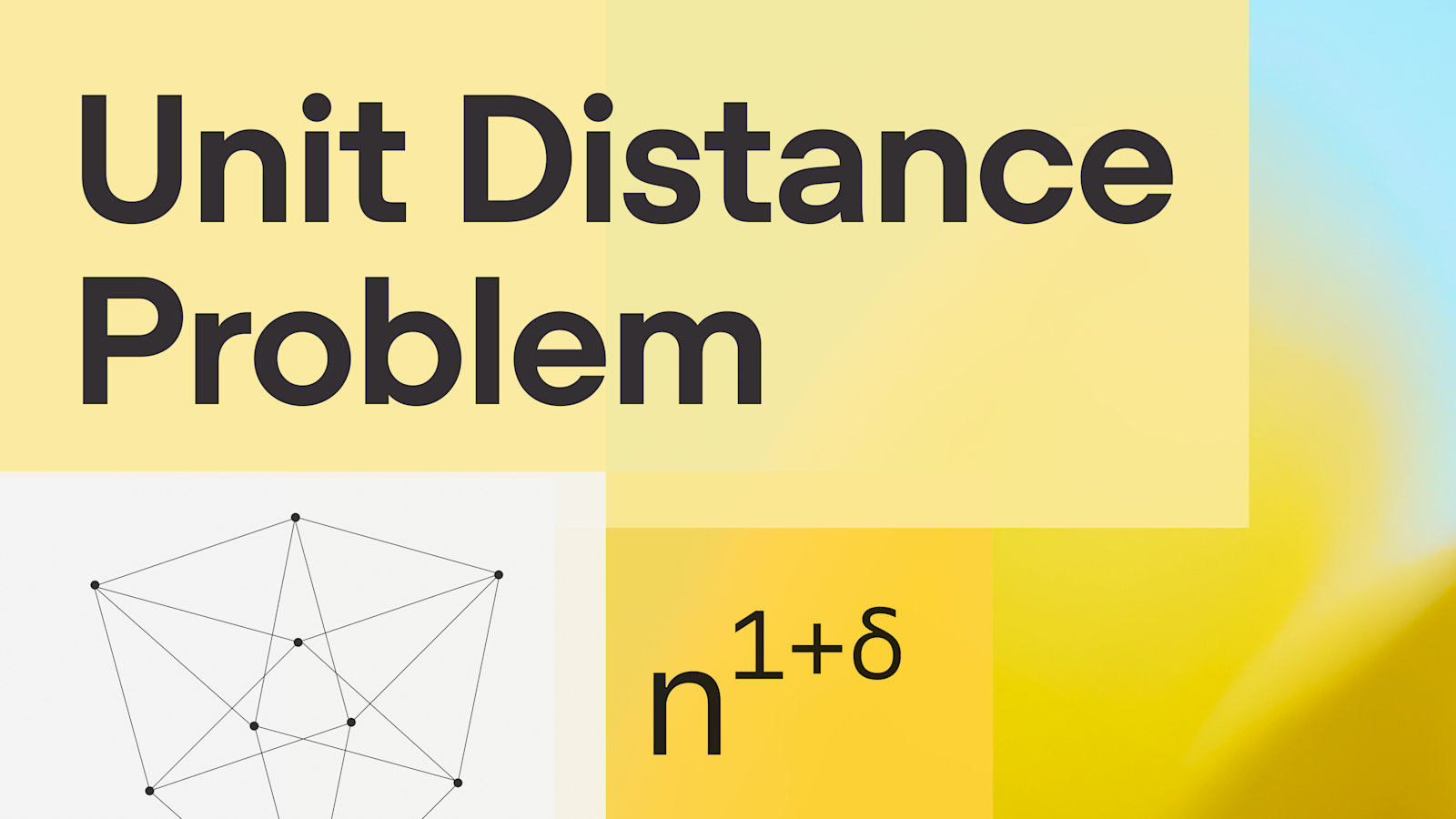
Image: OpenAI official blog — Polynomial construction for the unit distance problem
1. A Shocking Announcement in Mathematics
On May 20, 2026, OpenAI announced that its internal general reasoning model had autonomously solved a central open problem in discrete geometry—the Erdős unit distance problem, overturning a conjecture that had dominated the field for nearly 80 years.
This marks the first time an AI system has done all of the following:
- 🤖 Autonomously proposed an original proof
- 🔗 Connected different fields (algebraic number theory ↔ combinatorial geometry)
- ✅ Passed rigorous peer review by world-class mathematicians
- 🏆 Solved a central open problem in a mature mathematical subfield
“For nearly 80 years, mathematicians believed the optimal configuration roughly resembled a square grid. An OpenAI model has now overturned that belief, discovering an entirely new family of constructions with better performance.” — OpenAI, May 20, 2026
2. The Problem: Erdős’s Deceptively Simple Question
In 1946, Hungarian mathematician Paul Erdős (1913–1996) posed a problem simple enough to explain to a child, yet profound enough to baffle the brightest minds for nearly a century:
The Question
Given (n) points in the plane, what is the maximum number of pairs that are exactly 1 unit apart?
Formally, if we define (u(n)) as the maximum number of unit-distance pairs among (n) points:
[u(n) = \max_{\substack{P \subset \mathbb{R}^2 \ |P| = n}} \big|{{p, q} \subset P : |p - q| = 1}\big|]
Visual Intuition
Imagine placing points on paper. The challenge: how to arrange them so that as many pairs as possible are exactly one unit apart?
    •─────•                    •──•──•    │\   /│                    │\/|\/|    │ \ / │                    │/\|/\|    •──X──•         vs.        •──•──•    │ / \ │                    │\/|\/|    │/   \│                    │/\|/\|    •─────•                    •──•──•
  Random placement           Square grid (Erdős construction)  (few unit distances)       (many unit distances)
3. 80 Years of Mathematical Consensus
Lower Bound: Erdős’s Grid Construction (1946)
Erdős himself provided the foundational lower bound using an elegantly simple construction: a rescaled square grid.
    •──•──•──•──•──•    │  │  │  │  │  │    •──•──•──•──•──•    │  │  │  │  │  │    •──•──•──•──•──•    │  │  │  │  │  │    •──•──•──•──•──•    │  │  │  │  │  │    •──•──•──•──•──•
By carefully scaling the grid so many distances are exactly 1, Erdős proved:
[u(n) \geq n^{1 + \frac{c}{\log\log n}} \quad \text{for some constant } c > 0]
Since (\frac{c}{\log\log n} \to 0) as (n \to \infty), this is “almost linear”—the exponent approaches 1 but never reaches a fixed value greater than 1.
Upper Bound: Spencer–Szemerédi–Trotter (1984)
In 1984, Joel Spencer, Endre Szemerédi, and William T. Trotter established the best-known upper bound using the then-revolutionary crossing number inequality:
[u(n) = O(n^{4/3})]
This bound stood for 40 years.
The Central Conjecture
The overwhelming consensus among mathematicians was that Erdős’s lower bound was essentially optimal:
Conjecture (Erdős, 1946): The maximum number of unit distances grows as (n^{1+o(1)}). In other words: [u(n) = n^{1 + o(1)}] The square grid construction is essentially optimal.
Gap Summary
| Result | Year | Type | Formula |
|---|---|---|---|
| Erdős lower bound | 1946 | Lower bound | (n^{1 + c/\log\log n}) |
| SST upper bound | 1984 | Upper bound | (O(n^{4/3})) |
| Erdős conjecture | 1946 | (believed correct) | (n^{1+o(1)}) |
| AI overturns | 2026 | New lower bound | (\geq n^{1+\delta}), (\delta > 0) fixed |
4. The AI Breakthrough: Overturning a Conjecture
The Result
OpenAI’s general reasoning model—trained with reinforcement learning and equipped with extended chain-of-thought capabilities—completed the full proof in a single generation session.
Theorem (AI-generated, 2026): There exists an infinite family of planar point set constructions such that for infinitely many (n), the number of unit-distance pairs is at least: [u(n) \geq n^{1 + \delta}] where (\delta > 0) is a fixed positive constant.
This fundamentally disproves Erdős’s (n^{1+o(1)}) conjecture—the number of unit distances can grow polynomially beyond linear, not just “almost linearly.”
Key Figures
| Metric | Value | Significance |
|---|---|---|
| Original AI proof | (\delta > 0) (implicit) | Existence of a fixed gap |
| Will Sawin’s improvement | (\delta = 0.014) | Explicit verifiable constant |
| Time to solve | ~80 years | From 1946 to 2026 |
| Human guidance | None | Fully autonomous |
5. The Proof: Cross-Domain Ingenuity
What stunned mathematicians was not just the result, but the method. The model introduced tools from algebraic number theory into an elementary geometry problem—a connection no human mathematician had explored before.
Two Perspective Shifts
Number theorist Arul Shankar explained in the companion paper “Remarks on the disproof of the unit distance conjecture” (arXiv:2605.20695):
Shift 1: Fix the Primes, Vary the Field
Traditionally, number theorists fix a number field and vary primes. The AI proof reversed this perspective:
Traditional: Fix field (K), vary primes (p)
AI proof: Fix prime set (S), vary field (K)—vary the number field over a fixed set of primes
This technique is common in arithmetic statistics, but nearly unprecedented in combinatorial geometry of fixed dimension.
Shift 2: Class Field Towers
Instead of using number fields of bounded degree, the proof employed class field towers—infinite towers of field extensions from class field theory:
[K = K_0 \subset K_1 \subset K_2 \subset \cdots \subset K_n \subset \cdots]
where each (K_{i+1}) is the Hilbert class field of (K_i).
Class Field Tower Construction
graph TD
    subgraph "Class Field Tower Construction"
        K0["$K_0 = K$
Base field"] --> K1["$K_1 = H(K_0)$
Hilbert class field"]
        K1 --> K2["$K_2 = H(K_1)$
Hilbert class field"]
        K2 --> K3["$K_3 = H(K_2)$
Hilbert class field"]
        K3 --> K4["$\cdots$"]
        K4 --> Ki["$K_i$"]
        Ki --> Kinf["$K_\infty$
Infinite tower"]
    end

    subgraph "Connecting to Geometry"
        K0 -.->|"Ring of integers"| O0["$\mathcal{O}_K$"]
        O0 -->|"Embedding"| C["$\mathbb{C}^r$"]
        C -->|"Generates point set"| U["Unit distances
in the plane"]
    end

    style K0 fill:#e1f5fe
    style K1 fill:#b3e5fc
    style K2 fill:#81d4fa
    style K3 fill:#4fc3f7
    style Ki fill:#29b6f6
    style Kinf fill:#0288d1,color:#fff
The Golod-Shafarevich Connection
The proof leverages Golod-Shafarevich theory, which provides conditions for a class field tower to be infinite:
Golod-Shafarevich Theorem: If a number field (K) has sufficiently many ramified primes relative to its degree, then its class field tower is infinite.
This infinite extension creates enough algebraic structure to produce point sets with the desired (n^{1+\delta}) unit distances.
6. Independent Verification and Academic Endorsement
Learning from the controversy in October 2025 (when GPT-5 claimed to have solved Erdős problems, only to be debunked by mathematician Thomas Bloom as simple literature retrieval), OpenAI conducted rigorous independent verification:
Verifying Mathematicians
| Mathematician | Institution | Credentials | Assessment |
|---|---|---|---|
| Tim Gowers | Cambridge / Collège de France | Fields Medalist (1998) | “A milestone for AI mathematics” |
| Noga Alon | Princeton University | Combinatorics leader | “One of Erdős’s favorite problems… a remarkable achievement” |
| Arul Shankar | University of Toronto | Leading number theorist | “AI models are no longer limited to being human assistants” |
| Thomas Bloom | Oxford University | Erdős problem website maintainer | “AI is helping us explore the cathedral of mathematics” |
| Will Sawin | Princeton University | Algebraic geometer | Improved the result to (\delta = 0.014) |
| Melanie Matchett Wood | Harvard University | Number theorist | Co-author of companion paper |
Companion Paper
The companion paper “Remarks on the disproof of the unit distance conjecture” was authored by an all-star team:
- Noga Alon (Princeton)
- Thomas Bloom (Oxford)
- Tim Gowers (Cambridge)
- Daniel Litt (Toronto)
- Will Sawin (Princeton)
- Arul Shankar (Toronto)
- Jacob Tsimerman (Toronto)
- Melanie Matchett Wood (Harvard)
📄 arXiv: 2605.20695
7. Timeline: From Conjecture to Overturn
timeline
    title Erdős Unit Distance Problem—80-Year Journey

    1946 : Paul Erdős poses the problem
         : Proposes $n^{1+o(1)}$ conjecture
         : Introduces square grid lower bound

    1952 : Moser improves upper bound
         : $u(n) \leq O(n^{3/2})$

    1984 : Spencer–Szemerédi–Trotter
         : Crossing number method
         : $u(n) = O(n^{4/3})$ (still best upper bound)

    1990s : Elekes introduces polynomial method
           : Székely crossing number proof

    2010 : Guth–Katz distinct distances
          : Polynomial partitioning revolution

    2015 : Guth–Katz prove distinct distance bound
          : New techniques energize the field

    Oct 2025 : GPT-5 controversy
              : Claims 10 Erdős problems solved
              : Debunked by Thomas Bloom
              : (OpenAI's learning moment)

    May 2026 : 🤖 AI breakthrough
              : OpenAI reasoning model overturns conjecture
              : Class field tower meets combinatorial geometry
              : $\delta = 0.014$ (Sawin improvement)
              : Erdős problem website updated to disproven
8. Key Code Example
Reference Implementation for Counting Unit Distances
import numpy as npfrom itertools import combinationsfrom typing import List, Tuple
def count_unit_distances(points: List[Tuple[float, float]],                         eps: float = 1e-9) -> int:    """    Count the number of unit-distance pairs in a set of points.
    This is the fundamental computational problem posed by Erdős.
    Args:        points: list of (x, y) coordinates        eps: tolerance for floating-point comparison
    Returns:        number of pairs at distance exactly 1 (within tolerance)
    Time complexity: O(n²)—checks all pairs    Space complexity: O(1) extra    """    count = 0    n = len(points)
    for i, j in combinations(range(n), 2):        x1, y1 = points[i]        x2, y2 = points[j]
        dist_sq = (x2 - x1)**2 + (y2 - y1)**2
        if abs(dist_sq - 1.0) < eps:            count += 1
    return count

def erdos_grid_construction(n: int) -> List[Tuple[float, float]]:    """    Erdős's original rescaled square grid construction.
    This construction achieves roughly n^(1 + c/log(log(n))) unit distances.    """    m = int(np.sqrt(n))    scale = 1.0
    points = []    for i in range(m):        for j in range(m):            points.append((i * scale, j * scale))
    return points[:n]

# Example: compare constructionsif __name__ == "__main__":    n = 100
    random_points = [(np.random.random(), np.random.random())                     for _ in range(n)]    random_count = count_unit_distances(random_points)
    grid_points = erdos_grid_construction(n)    grid_count = count_unit_distances(grid_points)
    print(f"n = {n} points")    print(f"Random placement: {random_count} unit distances")    print(f"Grid construction: {grid_count} unit distances")    print(f"Theoretical maximum (conjectured): ~{n:.0f}")    print(f"AI lower bound (n^1.014): {n**1.014:.1f}")
9. Why This Time Is Different
Previous AI mathematical achievements belonged to different categories. This breakthrough represents a paradigm shift:
AI's Role in Mathematics├── Competition math (IMO gold-level problems—structured, limited innovation)├── Formal verification (Lean/Coq—verifies existing theorems, no original discovery)├── Literature synthesis (GPT-5 Oct 2025—retrieves known results, debunked)└── 🏆 This breakthrough ├── Original proof generation ├── Cross-domain connection ├── No human step-by-step guidance ├── Expert peer review └── Solves central open problem| Dimension | Previous AI Math | This Result |
|---|---|---|
| Originality | Reconstructs known proofs | Entirely new argument in the literature |
| Autonomy | Human-guided, tool-assisted | Fully autonomous, general model |
| Importance | Competition problems | Central problem in a subfield |
| Cross-domain | Single domain | Number theory → Geometry |
| Verification | Automated checking | Human expert review |
| Training | Domain-specific fine-tuning | General reasoning only |
10. Deeper Implications
Beyond Mathematics
This breakthrough signals capabilities far beyond geometry:
- 🧬 Biology—Discovering new drugs and protein structures
- ⚛️ Physics—Proposing new theories and models
- 🧪 Materials Science—Designing new materials
- 🔬 Medicine—Discovering new treatments
- 🏗️ Engineering—Solving complex design problems
OpenAI’s Assessment
“Maintaining coherence across complex reasoning chains, connecting ideas across domains, and finding paths researchers might not have explored—these capabilities apply equally to biology, physics, materials science, engineering, and medicine. This is a step toward more automated research.”
The Human Role Remains Indispensable
| AI Does | Humans Still Do |
|---|---|
| Search vast idea spaces | Choose which problems matter |
| Suggest novel connections | Explain results intuitively |
| Verify formal correctness | Ask the right follow-up questions |
| Explore “long shot” approaches | Guide research agendas |
| Generate candidate proofs | Identify deep structural truth |
As Thomas Bloom—the same mathematician who debunked OpenAI’s October 2025 claims—said:
“What invisible wonders are still waiting to be discovered?”
References
- 📝 OpenAI Official Blog (May 20, 2026): An OpenAI model has disproved a central conjecture in discrete geometry
- 📄 Companion Paper: Noga Alon, Thomas Bloom, Tim Gowers, Daniel Litt, Will Sawin, Arul Shankar, Jacob Tsimerman, Melanie Matchett Wood, “Remarks on the disproof of the unit distance conjecture”, arXiv:2605.20695. Link
- 🌐 Erdős Problem Website: erdosproblems.com—status updated to disproven
- Interesting Engineering: “80-year-old geometry mystery cracked by OpenAI using deep number theory”
- Yahoo Tech: “OpenAI claims it solved an 80-year-old math problem”
- AI Wins News: “OpenAI Model Disproves 80-Year-Old Unit Distance Conjecture”
This article is compiled from public sources, including OpenAI’s official announcement, the arXiv companion paper, and verified news reports.
Last updated: May 21, 2026