Google I/O 2026 Deep Dive: The Paradigm Shift from AI Assistants to AI Agents
Date: May 19, 2026 (Pacific Time)
Location: Shoreline Amphitheatre, Mountain View, California
Theme: Agentic Era
Core Narrative: AI is no longer just a tool that answers questions, but a digital agent that executes tasks for you in the cloud 24/7
1. Conference Overview: A Clear Strategic Pivot
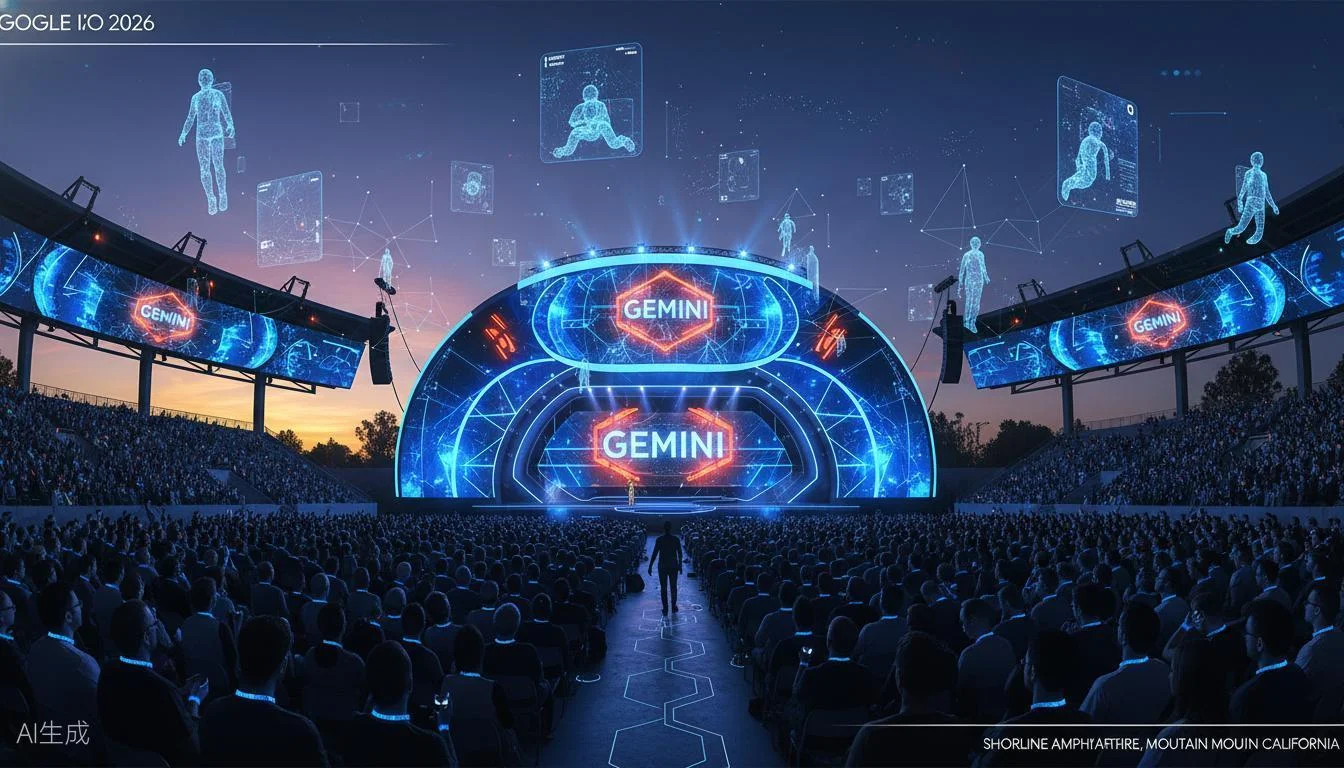
The 2026 Google I/O was the most strategically clear edition in recent years. CEO Sundar Pichai set the tone within minutes of opening: this year belongs to Agents — no longer AI assistants that answer questions and generate content, but software agents that can autonomously plan, execute, and verify their own work. (Sina Finance) This narrative ran through every segment of the keynote: from the release of the Gemini 3.5 model family, to the unveiling of the Gemini Spark personal agent, to the full AI-powered reinvention of Google Search, and the Antigravity 2.0 platform for developers — every major announcement pointed in the same direction.
Pichai revealed a striking set of numbers: Google now processes 32 quadrillion tokens per month, a 7x increase year-over-year; Gemini’s monthly active users have surpassed 900 million. (Sina Finance) This means Google’s AI infrastructure is now capable of supporting large-scale agentic workloads at scale, and this year’s I/O was the window to show the world how this capability translates into end-user product experiences.
Notably, this year’s I/O had almost no announcements about Android 17 — that content was already released at the Android Show the prior week. This signals on a side note that in Google’s strategic priorities, AI agents have overtaken mobile OS updates as the company’s core focus for resource allocation.
2. Gemini 3.5 Model Family: A New Balance of Speed and Intelligence

2.1 Gemini 3.5 Flash: The “Default Model” Now Live
Gemini 3.5 Flash was the first product to debut at I/O and had the most immediate impact. It went live globally on its release day (May 19), becoming the default model for Gemini App, Google Search AI Mode, Gemini API, AI Studio, and the Antigravity platform. (Gadgets 360)
Google pitched three core selling points for this model:
| Dimension | Gemini 3.5 Flash Performance | Baseline Comparison |
|---|---|---|
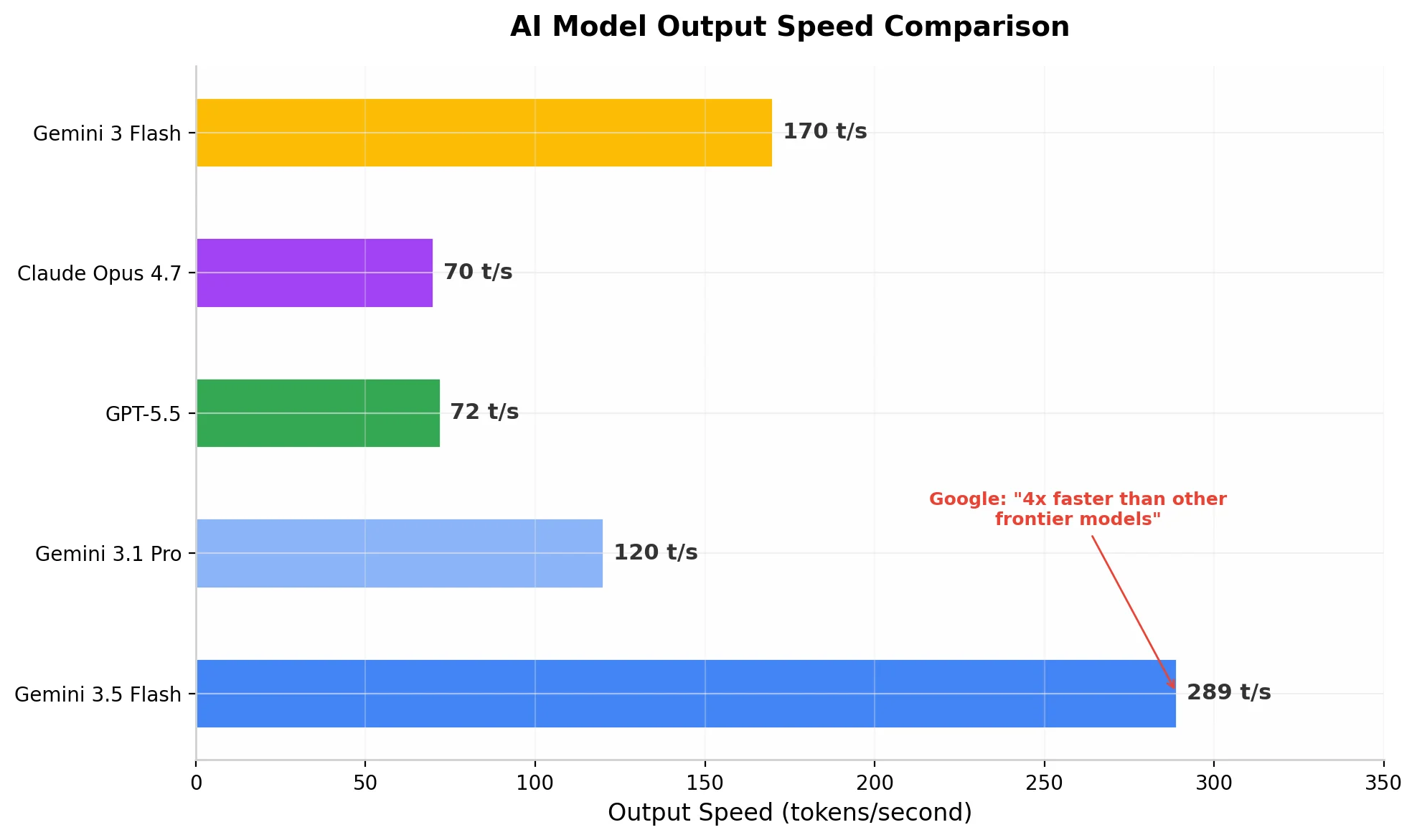
| Output Speed | 289 tokens/sec (DoNews) | 4x faster than Claude Opus 4.7 and GPT-5.5 |
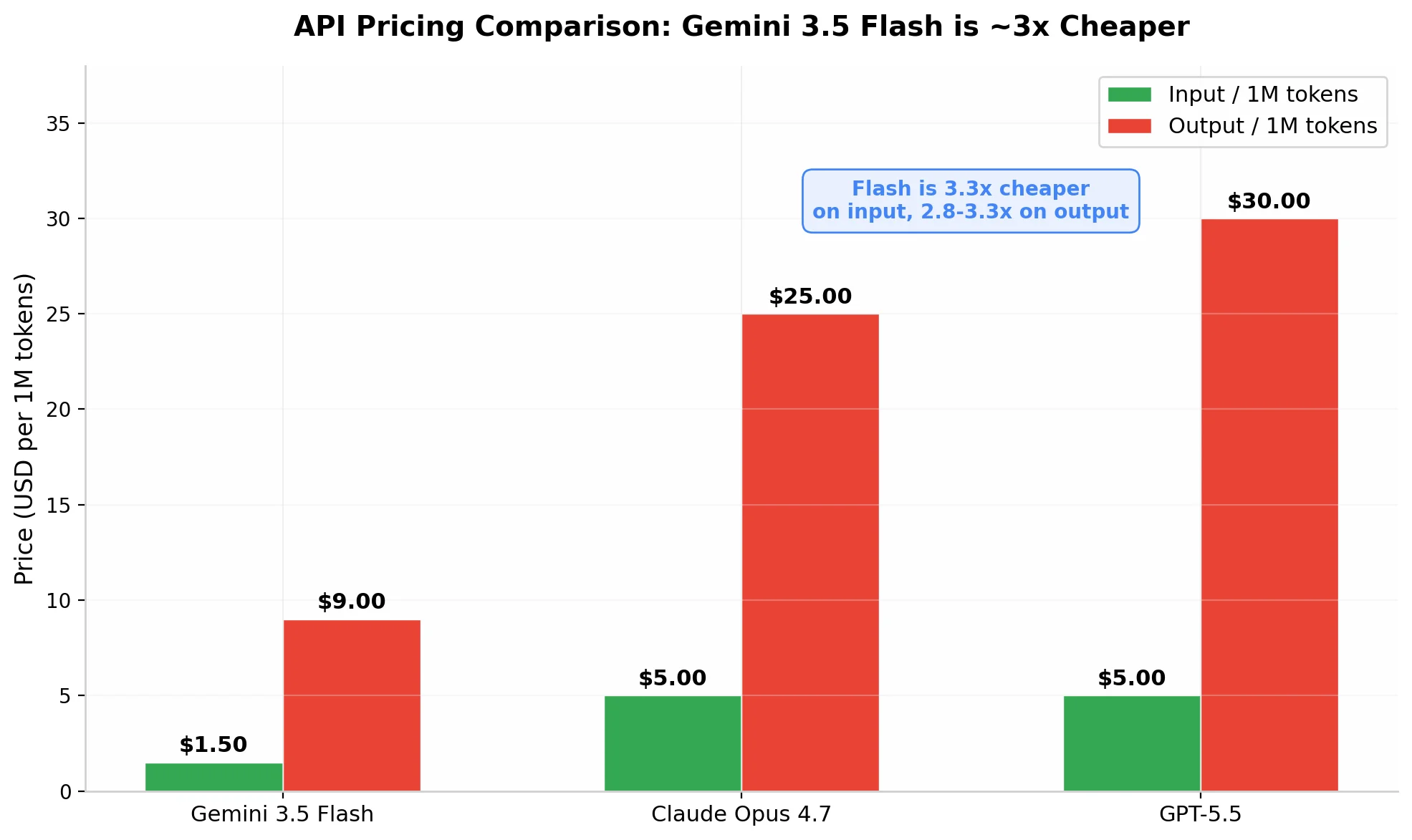
| API Cost | $1.50 / $9.00 (per million input/output tokens) (digitalapplied.com) | 3x cheaper than competing Pro-tier models |
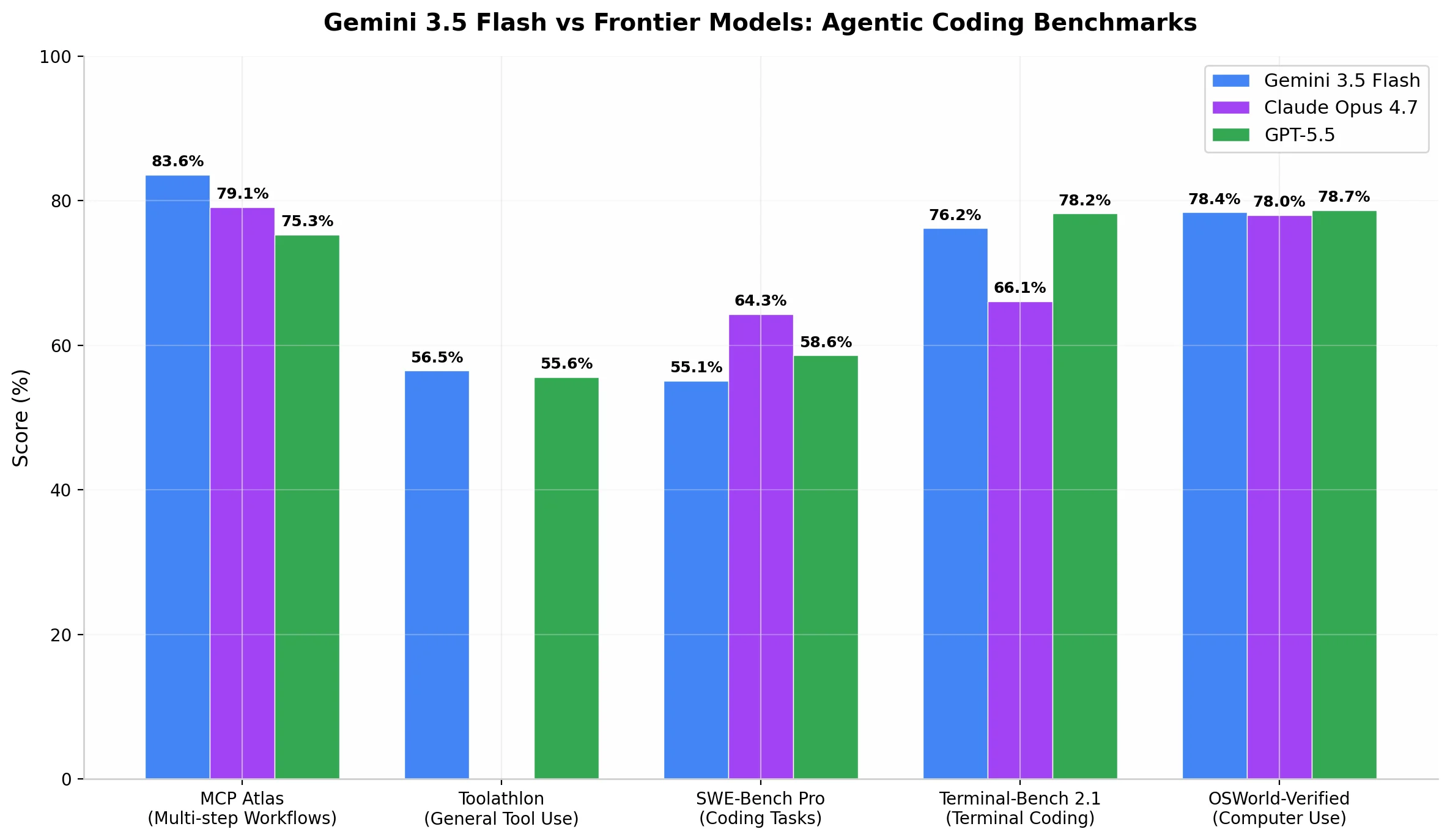
| Agent Performance | MCP Atlas 83.6%, Toolathlon 56.5% (digitalapplied.com) | Surpasses Gemini 3.1 Pro, ahead of GPT-5.5 and Claude Opus 4.7 |
Looking at the benchmark data, Gemini 3.5 Flash’s positioning is quite clever. It doesn’t beat competitors in every dimension, but it establishes a clear advantage in Agentic workflows (MCP Atlas, Toolathlon) and speed-to-cost ratio — the two dimensions Google cares about most. For agent scenarios where the model needs to repeatedly call tools in a tight loop and execute multi-step tasks, the cumulative effect of 4x faster and 3x cheaper per call means wall-clock time and total cost could be reduced by an order of magnitude. (digitalapplied.com)
2.2 The Stunning Demo: Generating an Operating System in 12 Hours
On the I/O stage, Google presented a compelling case study: using the Antigravity platform and Gemini 3.5 Flash, 93 sub-agents working in parallel generated a fully functional operating system core in 12 hours, processing nearly 2.6 billion tokens at an API cost of under $1,000. (Gadgets 360) The demo team even managed to run the classic game Doom on this AI-generated OS — though the first attempt failed due to a missing keyboard driver, Antigravity then generated the required driver in real time and fixed the issue.
The deeper implication of this demo: it proved Gemini 3.5 Flash is not just a “faster model” but an infrastructure-grade component capable of driving large-scale autonomous agent collaboration. For enterprises, this means a reallocation of annual token budgets — Google estimates that if a top tech company migrates 80% of its daily workloads to Gemini 3.5 Flash, it could save over $1 billion annually. (DoNews)
2.3 Gemini 3.5 Pro and Gemini Omni
Gemini 3.5 Pro is still in internal testing at Google, expected to officially launch in June 2026. As a Pro-tier model, it will compensate for Flash’s shortcomings in long-context processing (MRCR v2) and knowledge-intensive tasks (Humanity’s Last Exam), forming a truly competitive match against GPT-5.5 and Claude Opus 4.7. (sohu.com)
Gemini Omni represents Google’s latest exploration in the “world model” direction. It supports text, image, audio, and video as any input, and can output generated video, blending Gemini’s reasoning capabilities with the creativity of generation models like Nano Banana and Veo. (sohu.com) DeepMind CEO Demis Hassabis sees it as a major milestone toward AGI — Omni can not only understand gravity and kinetic energy in the physical world but also edit any element in a video through conversational commands. (MacRumors) Omni Flash is already available to Google AI Plus/Pro/Ultra subscribers and YouTube Shorts creators.
3. Gemini Spark: Your 24/7 Personal AI Agent
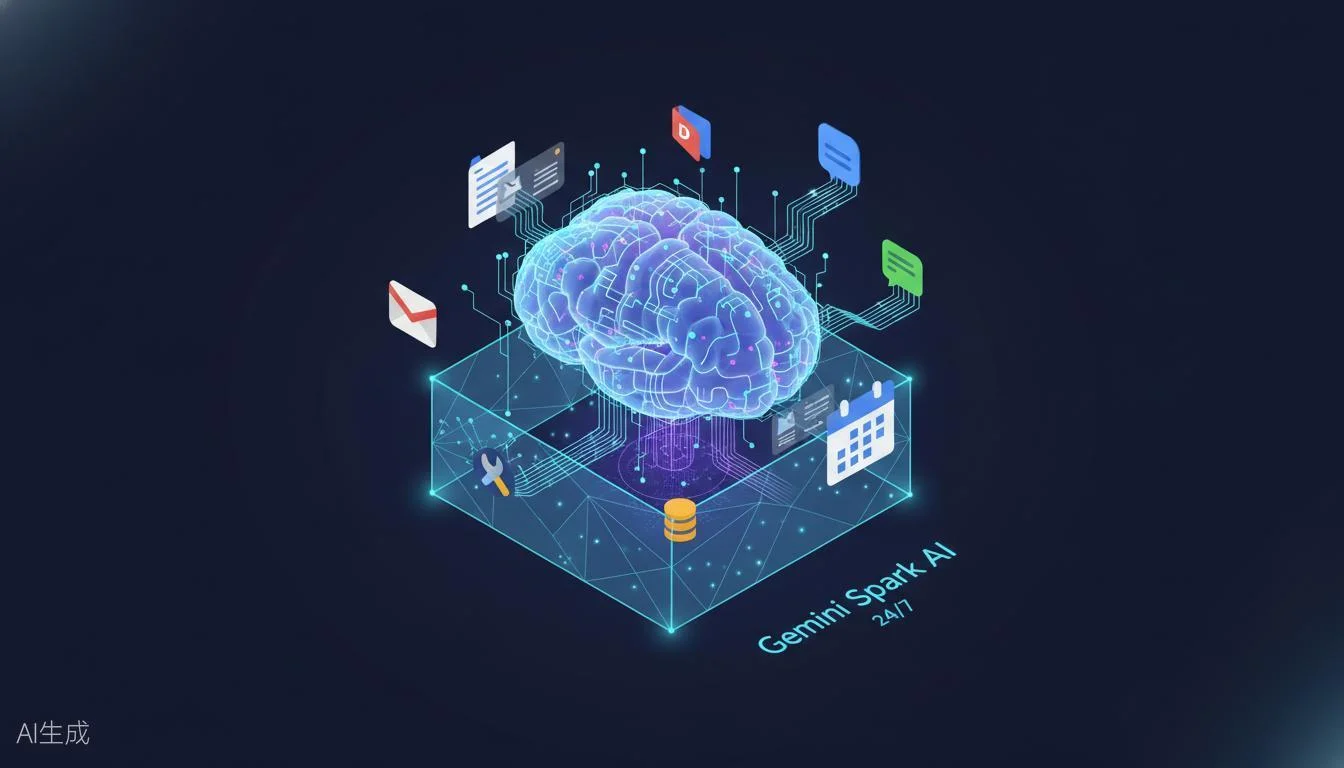
If Gemini 3.5 Flash is the infrastructure of the agent era, then Gemini Spark is the first killer app aimed at everyday consumers. It is Google’s first truly “personal AI agent” — it runs on dedicated virtual machines in Google Cloud, requiring neither your phone to be unlocked nor your computer to be on, to continuously execute tasks in the background. (FoneArena.com)
3.1 Spark’s Core Capabilities
Spark’s launch marks a fundamental shift in Google’s product philosophy: evolving from “you ask, I answer” conversational AI to “I’ll do it for you” agentic AI. Its typical use cases include:
- Automatic bill analysis: scans credit card statements monthly, flags hidden subscription fees and unusual transactions
- Email monitoring and summarization: monitors school and work-related emails, extracts important deadlines, sends daily digests to you and your partner
- Workflow automation: consolidates meeting notes scattered across Gmail and Docs into standardized documents, and drafts follow-up emails
- Third-party service integration: connects to Canva, OpenTable, Instacart and other services via MCP (Model Context Protocol) to execute cross-application tasks (FoneArena.com)
Google emphasizes that Spark will actively request user permission before performing high-risk operations like sending emails or making payments, and users can control the scope of applications and behavioral boundaries the agent can access at any time. (Tom’s Guide) However, the official documentation also includes an honest disclaimer: Spark “might share information or make purchases without asking.” (Decrypt)
3.2 Rollout Plan and Ecosystem Expansion
Spark’s rollout follows a gradual strategy:
| Time | Audience | Details |
|---|---|---|
| Week of May 19 | Trusted Testers | First closed beta slots (Tosea.ai) |
| Week of May 26 | US Google AI Ultra subscribers | Beta opens (Sina Finance) |
| Summer 2026 | macOS users | Gemini Mac App integrates Spark, supports local file operations (MacRumors) |
| Summer 2026 | More third-party apps | DoorDash, Asana, Dropbox, Uber MCP integrations (Tom’s Guide) |
Spark’s deep competitive advantage lies in its native integration with Google Workspace. Unlike OpenClaw and other solutions that require users to open up their local devices, Spark runs entirely in the cloud, meaning it can deeply access data in Gmail, Docs, Sheets, and Slides without compromising device security. (Decrypt) This summer, Spark will also gain SMS and email command capabilities — you can send Spark an email or text message directly to assign tasks.
4. Google Search Fully AI-Powered: A Paradigm Revolution of the Search Box

4.1 From Search Engine to Task Engine
At this year’s I/O, the transformation of Google Search might be the most far-reaching change for ordinary users. Google is restructuring Search from an “information retrieval tool” into a “task execution engine” — one that can not only answer questions, but proactively monitor, continuously track, and dynamically generate interfaces. (The Keyword)
The most visible change is the redesigned AI Mode search box: the longer you type, the search box expands automatically; it supports AI-driven autocomplete that predicts user intent; powered by Gemini 3.5 Flash, it supports attaching documents, photos, videos, and even Chrome tabs for queries. (Sina Finance)
4.2 Three Major New Features
Information Agents are the key to Search’s transformation into a “proactive service.” Users can set up agents to monitor specific topics 24/7 — stock price movements, new property listings, sneaker releases, sports results, etc. — and when significant changes are detected, the agent proactively pushes notifications. (Sina Mobile) This means search behavior changes from “I actively search” to “it actively tells me.”
Mini Apps push Search capabilities toward personalized dashboards. Search can generate custom trackers and dashboards for specific tasks — like planning a wedding, managing a move, or building a health plan. (The Keyword) These Mini Apps are generated in real-time based on Antigravity’s agentic coding capabilities, able to call live data sources (local weather, maps, business reviews, etc.).
Generative UI is the technological culmination: based on search results, Search will dynamically generate different page layouts — an interactive simulator for physics questions, tables and charts for product comparisons, step-by-step cards for how-to guides. (The Keyword)
| Feature | Description | Release |
|---|---|---|
| AI Mode Redesign | Powered by Gemini 3.5 Flash, supports multimodal attachments for queries | Live now (The Keyword) |
| Information Agents | 24/7 background monitoring, proactive push updates | Summer 2026 (The Keyword) |
| Generative UI | Dynamically generates interactive interfaces based on queries | Summer 2026, free (The Keyword) |
| Mini Apps | Custom dashboards and task trackers | Coming months, Pro/Ultra first (The Keyword) |
| Personal Intelligence | Connects Gmail, Photos and other personal data | Expanded to nearly 200 countries (The Keyword) |
5. Smart Glasses (Android XR): Capturing the AI Wearable Gateway
5.1 Differentiated Dual Product Line Strategy
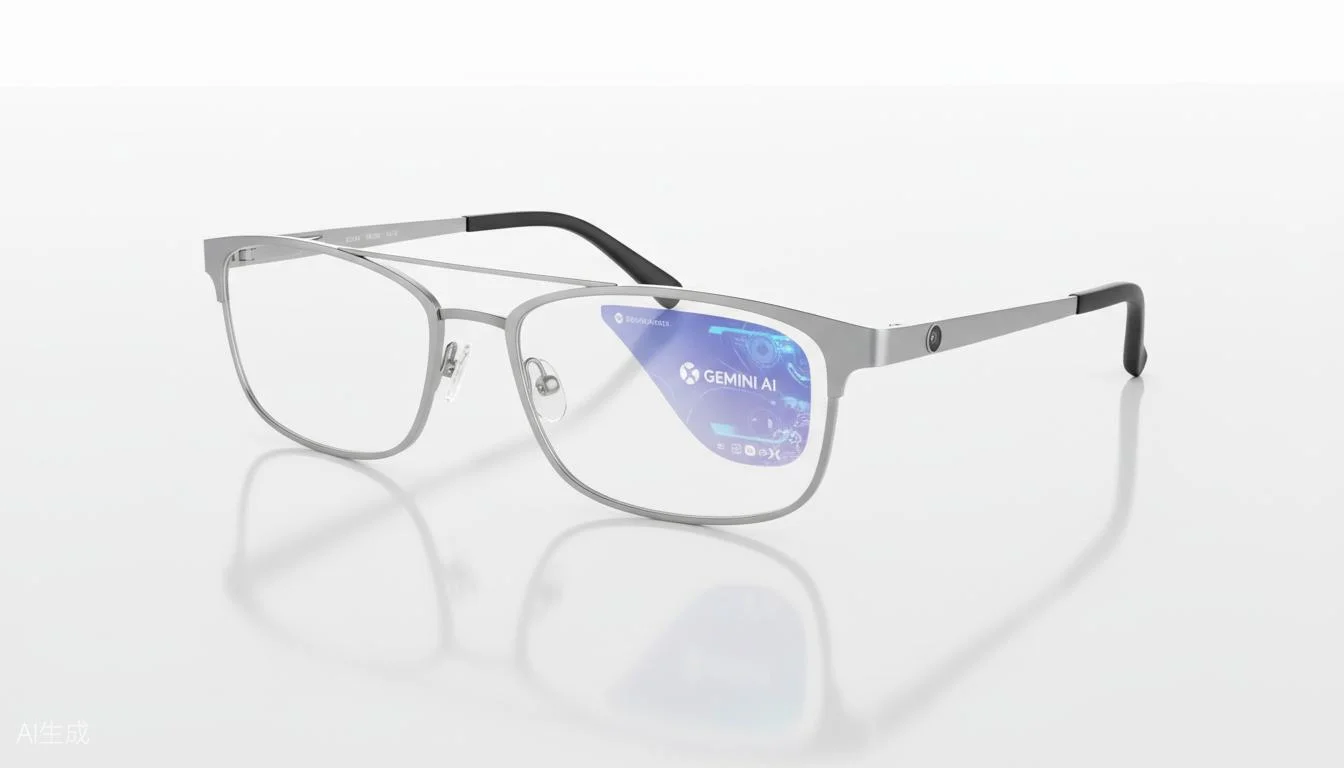
At I/O 2026, Google officially showcased the Android XR smart glasses product line developed in collaboration with Samsung (hardware), Qualcomm (chips), Gentle Monster and Warby Parker (design). (The Keyword) This is Google’s most serious return to the smart glasses space since the failure of Google Glass in 2015 — and this time, the strategy is clearly more pragmatic and differentiated.
Audio Glasses will launch in fall this year, the first product line to ship. They have no display, look close to ordinary optical glasses, and feature built-in speakers, microphone, and camera, supporting Gemini voice interaction, real-time translation, navigation guidance, and photo capture, compatible with both Android and iPhone. (The Keyword) In terms of positioning, they directly compete with Meta Ray-Ban smart glasses, but emphasize fashion sense more through design partnerships (Gentle Monster, Warby Parker).
Display Glasses are still in development, with micro-displays embedded in the lenses that can show text messages, real-time navigation arrows, and search result cards, supporting Nano Banana AI image generation. (aibase.com) This product presents greater technical challenges, with a correspondingly delayed release timeline.
| Specification | Audio Glasses | Display Glasses |
|---|---|---|
| Display | None | Single-lens micro-display (aibase.com) |
| Release | Fall 2026 (The Keyword) | In development, TBD |
| Core Interaction | Voice + bone conduction audio (The Verge) | Voice + visual cards (aibase.com) |
| Weight Target | < 46g (aibase.com) | Slightly heavier (with display module) |
| Battery Life | ~10 hours (aibase.com) | TBD |
| Chip | Qualcomm Snapdragon AR1 (The Verge) | Qualcomm XR2+ Gen 2 (aibase.com) |
| Design Partners | Gentle Monster, Warby Parker (The Keyword) | Samsung (display tech) (The Keyword) |
| Phone Compatibility | Android + iPhone (The Keyword) | Mostly Android |
5.2 Project Aura: “Wired XR Glasses” in Partnership with Xreal
Beyond the wireless glasses line with Samsung, Google also showcased the Project Aura prototype developed with Xreal — a wired XR glasses unit, connected via cable to a standalone computing module (doubling as a battery and trackpad). (TechRadar)
Project Aura is positioned more as a “head-mounted display” than everyday glasses. It offers a 70-degree field of view — the largest optical see-through display Xreal has ever produced, capable of overlaying rich digital content onto the user’s field of vision. (xreal.com) In demos, users could run Lightroom, watch YouTube, play 3D desktop games, and even identify artwork on walls via Circle to Search. (The Verge)
Project Aura’s strategic value is this: it provides a premium reference design for the Android XR ecosystem, demonstrating that Android XR applications can run on different form factors without modification. This is critical for solving the “app drought” problem that has long plagued the XR industry. (The Verge)
6. Workspace and Creative Tools: AI Upgrades Across the Productivity Suite
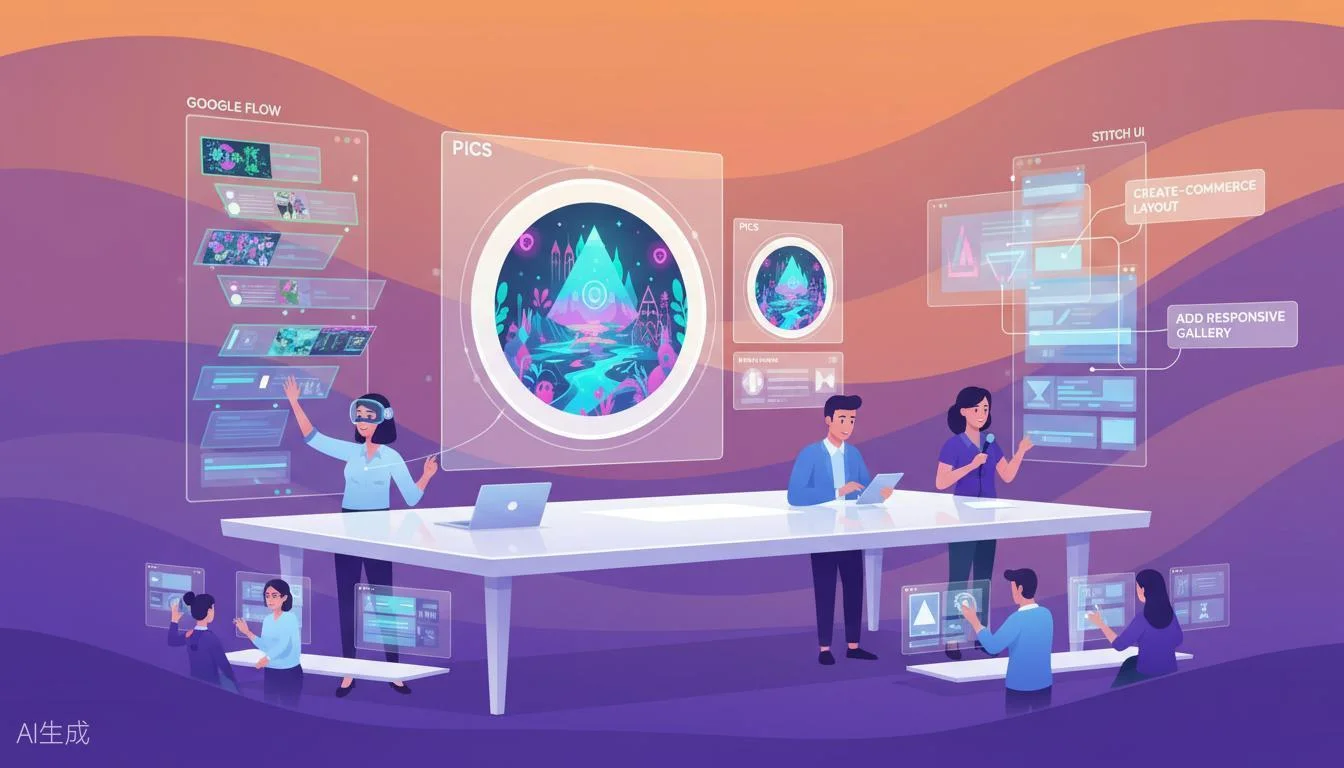
At this I/O, Google rolled out comprehensive AI-powered upgrades across the Workspace productivity suite, with nearly every core application gaining new AI capabilities:
6.1 Workspace Core Application Upgrades
| App | New Feature | Release | Subscription |
|---|---|---|---|
| Gmail Live | Conversational email search, natural language inbox queries (MacRumors) | Summer 2026 | Pro / Ultra |
| Docs Live | Voice-powered document creation and editing, AI auto-organizes “brain dumps” (MacRumors) | Summer 2026 | Pro / Ultra |
| Google Keep AI | Auto-organizes scattered ideas into structured, concise notes (Sina Mobile) | Rolling out | Plus / Pro / Ultra |
| AI Inbox | Smart inbox categorization and priority sorting (Tosea.ai) | Live now | Plus / Pro / Ultra |
| Universal Cart | Unified shopping cart across Search and Gemini App (Tosea.ai) | Live now | All users |
6.2 New Creative Tools Suite
At this I/O, Google launched a new set of tools aimed at creative professionals, forming a complete pipeline from image generation to UI design:
Google Pics is an AI image generation and design tool comparable to Canva, enabling users to create posters, flyers, infographics, and more — all generated content carries SynthID watermarking. (MacRumors) It will launch in summer 2026.
Stitch is a Figma-like UI/UX design tool that lets users transform rough ideas into polished interface designs through natural language prompts or voice commands — for example, saying “build an e-commerce product page with a blue color scheme and a user review section” and Stitch generates an exportable design. (MacRumors) New features this year include Stitch Agent for real-time collaborative design, exporting to Antigravity, and direct publishing to Netlify.
Google Flow / Flow Music are mobile AI video and music creation apps. Flow has integrated Gemini Omni, supporting cinematic video generation from text or images; Flow Music lets users upload recordings and then use prompts to have Gemini 3.5 generate additional musical elements. (MacRumors) Both apps are now live on iOS and Android.
7. Subscription and Billing Changes: Pricing for the Agent Era
Google made significant structural adjustments to its AI subscription system, reflecting the company’s deeper thinking about the “agentic AI” business model:
7.1 New Pricing Structure
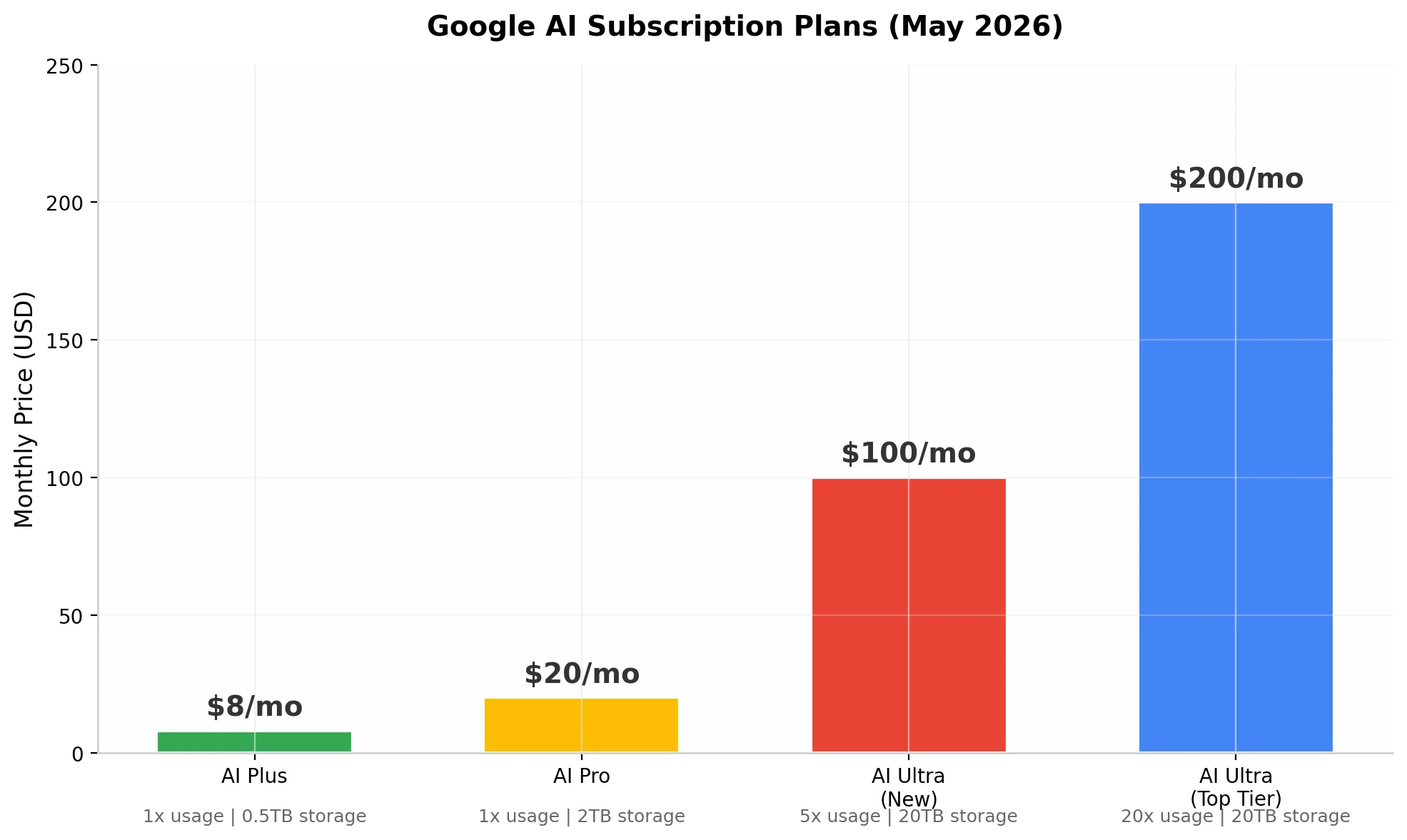
| Tier | Monthly Price | Gemini App Usage Limit | Core Benefits |
|---|---|---|---|
| AI Plus | $8 | 1x (baseline) | Basic AI features, YouTube Premium Lite (The New Stack) |
| AI Pro | $20 | 1x | Standard AI features, 2TB storage |
| AI Ultra (New) | $100 | 5x Pro | 20TB storage, YouTube Premium, Antigravity priority access (saudishopper.com.sa) |
| AI Ultra (Top) | $200 (was $250) | 20x Pro | Gemini Spark access, Project Genie (saudishopper.com.sa) |
7.2 From “Prompt Count” to “Compute Usage”
The most strategically significant change is not the price itself but the fundamental shift in billing model. Google is moving from traditional “daily prompt count limits” to a “compute-used” model — quotas are dynamically allocated based on prompt complexity, feature usage, and conversation length, refreshing every 5 hours. (Sina Finance)
The deeper implication of this change: Google wants you to run agents, not send chat messages. Agentic tasks typically involve hundreds of model calls, multi-round tool usage, and long-context maintenance — under the traditional “per-prompt” billing model, this usage pattern would quickly exhaust quotas. The “compute-based” billing model provides a more reasonable resource allocation framework for long-running agentic workloads. (Tosea.ai)
8. Developer Ecosystem: Antigravity 2.0 and AI Studio’s Vibe Coding
8.1 Antigravity 2.0: An Agent-First Development Platform
Antigravity 2.0 is Google’s core development infrastructure for the “agent era.” It has evolved from a pure coding environment into a comprehensive platform for developing and managing cohorts of autonomous AI agents. (Google for Developers Blog)
Key updates include:
- Standalone desktop app: Antigravity 2.0 is now a standalone desktop application on macOS, Linux, and Windows, with a CLI interface (Google for Developers Blog)
- Dynamic sub-agents: Developers can coordinate multiple specialized sub-agents to collaboratively complete complex tasks, all running in a cross-platform terminal sandbox with built-in credential masking and hardened Git policies (Google for Developers Blog)
- Speed-optimized version: Antigravity’s built-in Flash-optimized version achieves 12x the response speed of other frontier models (DoNews)
- Managed Agents API: Deploy a complete remote sandbox agent with a single API call (Google for Developers Blog)
The earlier-mentioned “12-hour OS generation” demo was powered by Antigravity 2.0’s agent orchestration capabilities. This case sends a clear signal to developers: Antigravity is not just a code generation tool, but an agent operating system capable of autonomous planning, coding, debugging, and deployment.
8.2 AI Studio: Natural Language to Android Apps
Google AI Studio has gained native Android support, officially entering the “Vibe Coding” arena. Developers can now describe app ideas in natural language, and AI Studio generates complete Kotlin code with a built-in Android emulator for real-time preview. (Digit)
The complete development-to-deployment pipeline:
- Describe app requirements in natural language (supports Chinese, English, etc.)
- AI Studio generates complete project code (based on Antigravity + Firebase)
- Test on the built-in emulator or connected physical device
- One-click export to Android Studio for further development
- Publish directly to Google Play Store (subject to existing review process) (Digit)
Currently, this feature is mainly targeted at lightweight utility apps. For apps requiring access to camera, GPS, and other hardware features, AI Studio can also generate the corresponding permission requests and API call code. (Digit)
9. Gemini for Science and WeatherNext: AI for Good
Near the end of the keynote, Demis Hassabis returned to the stage to share Google DeepMind’s latest scientific advancements. (Engadget)
Gemini for Science is a suite of AI tools for scientific researchers, including:
- AI Co-Scientist: A Gemini-based multi-agent virtual research collaborator that synthesizes vast amounts of information to generate new hypotheses and research proposals. In biomedicine, it has already proposed novel drug repositioning candidates for liver fibrosis that have passed laboratory validation (deepmind.google)
- AlphaEvolve: A Gemini-powered coding agent for designing advanced algorithms, already demonstrating value in Google data center efficiency optimization, chip design, and AI training pipeline improvements (deepmind.google)
- AlphaGenome: An AI model that helps scientists understand non-coding regions of DNA, promising to accelerate genomics biology and disease understanding (deepmind.google)
- WeatherNext: A family of state-of-the-art weather prediction models, already collaborating with the US National Hurricane Center to help predict hurricane paths. During 2025’s Hurricane Melissa, WeatherNext provided more accurate and aggressive predictions that helped regions like Jamaica prepare in advance (yahoo.com)
Hassabis closed his segment with a thought-provoking statement: “Artificial General Intelligence (AGI) is on the horizon. Built properly, it will advance human progress and prosperity beyond our wildest imaginations.” (yahoo.com)
10. Summary: Google’s Blueprint for the Agent Era
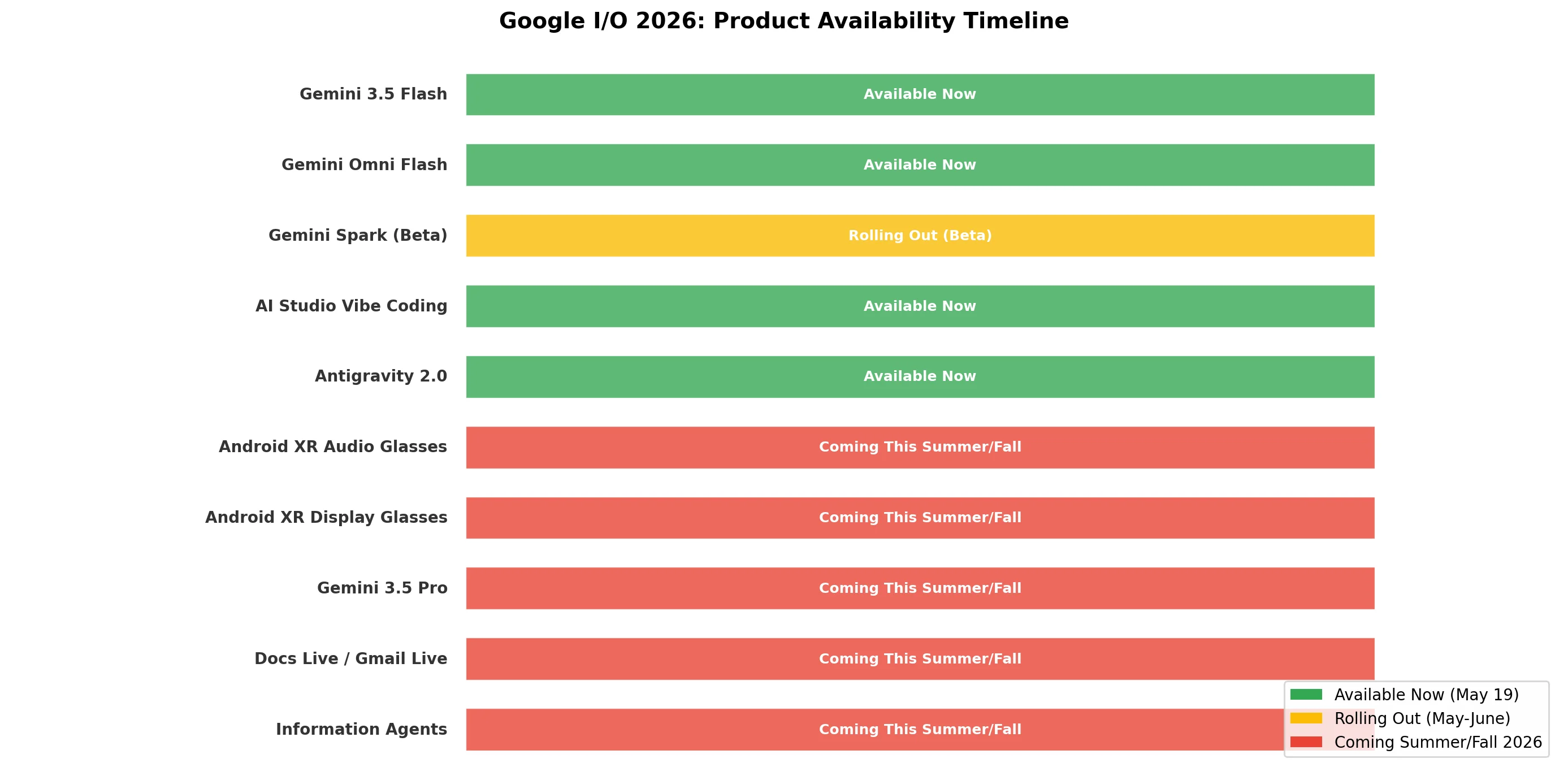
Looking back at Google I/O 2026 in its entirety, a clear strategic blueprint emerges:
At the model layer, Gemini 3.5 Flash becomes the default engine for agentic workloads with an optimal combination of “speed × intelligence × cost,” Omni pushes the boundaries of multimodal generation, and Pro will soon fill the gaps in long-context and knowledge depth.
At the application layer, Gemini Spark is Google’s flagship product in the transition to “agentic AI” — it’s no longer a chatbot waiting for instructions, but a digital employee running continuously in the cloud, proactively completing tasks.
At the gateway layer, the full AI transformation of Google Search and the Android XR smart glasses play show that Google is seeking the highest-frequency user touchpoints for agentic AI — the search box and wearable devices.
At the developer layer, Antigravity 2.0 and AI Studio’s Vibe Coding lower the barrier to building agent applications, inviting more developers to participate in building this ecosystem.
At the business model layer, the shift from “per-prompt” to “compute-based” billing signals Google’s expectation that the way AI is used will fundamentally change — no longer occasional conversations, but continuous agent operation.
As The Verge put it: “This year’s I/O had a clear core narrative — the evolution from ‘AI assistant’ to ‘AI agent’.”
This article draws on data and information from Google’s official blog, The Verge, 9to5Google, WIRED, MacRumors, and other media coverage, as well as the official Google I/O 2026 live stream.